
Every business has dozens of problems at any given time.
Even thriving ones.
A new regulation comes up and you have to comply.
You have to hire but can’t find the right candidate.
Or your clients churn and you have to find out why.
Being in business means dealing with problems.
It’s the same for your potential clients.
The problem your firm claims to solve is among a huge list of problems your buyers have.
They have limited time and resources.
But many problems to solve.
So how do they decide which ones are worth fixing?

Well, you probably know the Eisenhower Matrix.
It’s a simple matrix for productivity geeks to prioritize what tasks they have to do.
Depending on the importance and urgency of the task: you do, delegate, decide when to do, or eliminate it.
The funny thing is your buyers intuitively think this way.
When a problem is too pressing and important, they decide to fix it now.
But if a problem is neither important nor urgent, they ignore it.
So it looks like this:
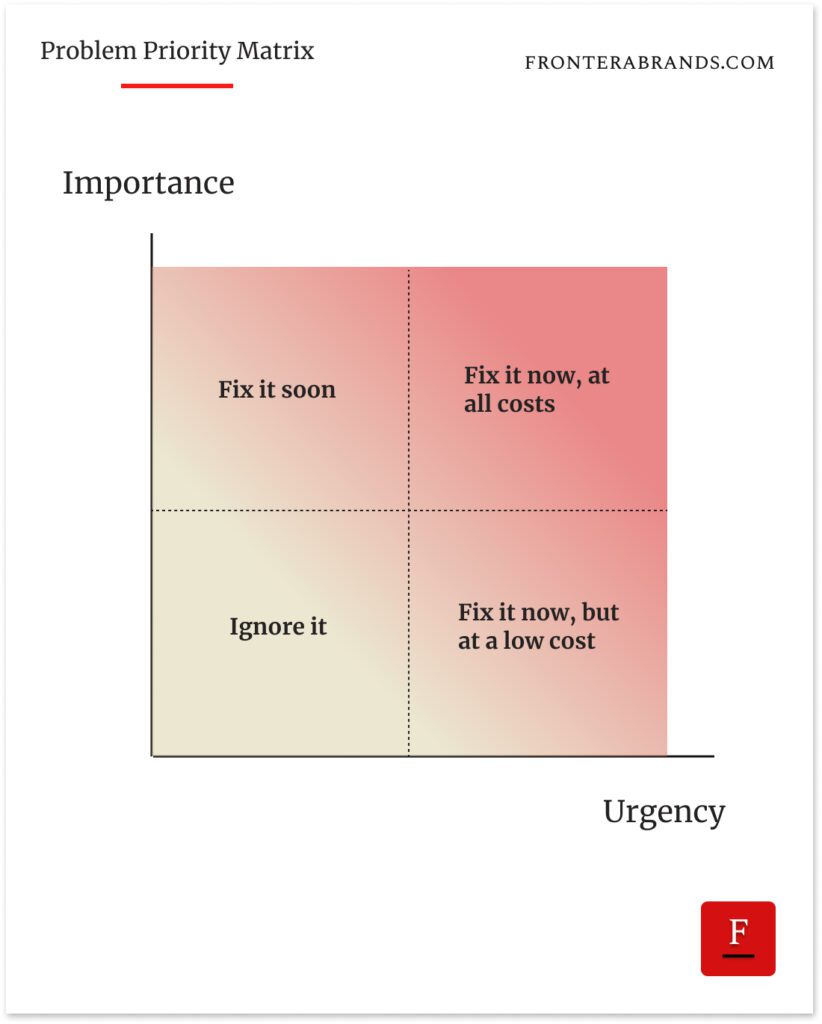
The Problem Prioritization Matrix makes one thing clear.
To sell your services more easily, you have to solve an important problem.
Otherwise, your problem ends up at the bottom of the buyers’ list.
It never gets resources.
But this is where things get interesting.
Because whatever service you offer, you actually solve multiple client problems.
For example.
Our brand strategy engagements help our clients solve different problems:
- “We can’t express our value in a clear way.”
- “We blend in with competitors.”
- “We’ve added too many services and it’s confusing.”
- “We lack clarity around our ideal client profile.”
- “Our conversion rate is low on our marketing channels.”
- “Our sales enablement material is weak.”
- “Our leadership team is not aligned around what we stand for and the direction of the business.”
So even a single service can be tied to multiple client problems.
It’s the same for your offers.
And depending on which one you choose to message on, you can increase its priority in the eyes of the buyer.
Then the question is:
How can you know which one is more important to buyers?
And how can you increase that problem’s urgency?
So among their huge list of problems, they decide to spend their resources on your problem.
Here are two ways:
1. Focus on emotional necessity
Let’s unpack the word “importance.”
What makes a problem important in the B2B context?
Sure, every consulting offer boils down to making or saving money.
But if you look a few layers deeper, the importance comes down to buyers’ emotional necessity.
Which problem you solve threatens your buyer’s credibility, reputation, or future the most?
Which problem causes the most annoyance?
Let’s say you have an IT firm that does CRM improvements.
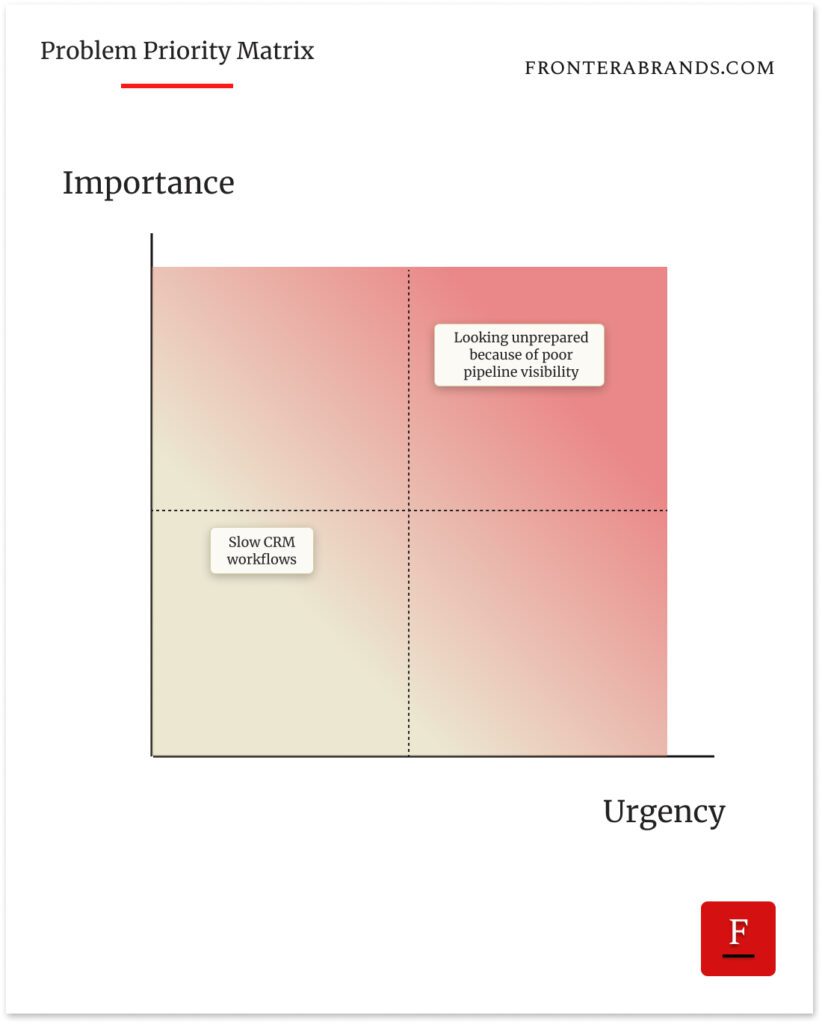
You can message about the “your CRM workflows are clunky and slow” problem.
Or you can message about “you look unprepared to your leadership team because of broken pipeline visibility.”
The same service.
Two different problems.
Which one has more emotional necessity to fix?
Which one would go higher on the buyers’ problem list?
A VP of sales can live with a slow CRM workflow.
Sure, he’d hear some complaints from his team every now and then.
But it wouldn’t get him fired.
So he might acknowledge that the problem exists, yet decide not to spend resources to fix it.
But he cannot afford to look incompetent in front of leadership with inaccurate information about their sales pipeline.
There is a higher emotional necessity to fix that problem.
And that means that the buyer would be more likely to spend resources when the same service is framed that way.
So what does this mean for your firm?
Well, your firm solves a wide range of problems for your clients.
List all of them.
Which one triggers more emotional necessity for your buyers to fix?
If you want to sell more easily, choose a problem where the stakes are visible, personal, and high.
And build your messaging around it.
Remember.
You’re not only competing with competitors who solve the same problem as you.
You also compete with your buyers’ other problems.
And they prioritize the problems they can’t afford to ignore emotionally.
2. Keep the problem top of mind
We’ve defined importance.
Now let’s focus on urgency.
Some business problems are inherently urgent — like tax declarations.
They come with deadlines that you can’t skip.
But many other problems are not like that.
Even when they are important, buyers might not feel the urgency to fix them today.
So how can you make your problem more urgent on the buyers’ list?
An easy way is by using selective perception.
Let me explain.
When you base your messaging around an important buyer problem and repeat it again and again, the problem stays top of mind.
So potential clients who regularly follow your content or see your ads start noticing the symptoms in their daily lives.
Hence your problem starts to feel more urgent than the rest.
If you can get a CEO to think about “low employee retention” again and again, that person will start paying attention.
A team leader who seems distracted in meetings.
A top performer updating her LinkedIn profile.
That reliable director taking random Tuesday afternoons off.
Suddenly, retention will go from HR’s problem to the CEO’s top three priorities.
The turnover problem was always there and important.
But selective perception makes it urgent.
So use your mental availability channels and repetition to keep your problem top of mind.
Your buyers will notice the symptoms and feel the urgency to act.
After all, that’s what good marketing does.
It changes priorities.
–
Enjoyed this article?
Then you’ll love the How Consultancies Win Newsletter.
Get the “7 Positioning Sins That Cost Consultancy Firms Millions” guide when you join. It’s free.
